
The increasing urgency and frequency of emerging infectious diseases necessitates faster, more agile and scalable vaccine solutions.1 While the rapid spread of health threats is exacerbated by factors such as urbanisation, climate change and global travel, increasing risks to public health and rising expectations for a swift solution mean that vaccine development must also be rapid. Yet, conventional strategies hamper the speed and agility that these clinical trials require.
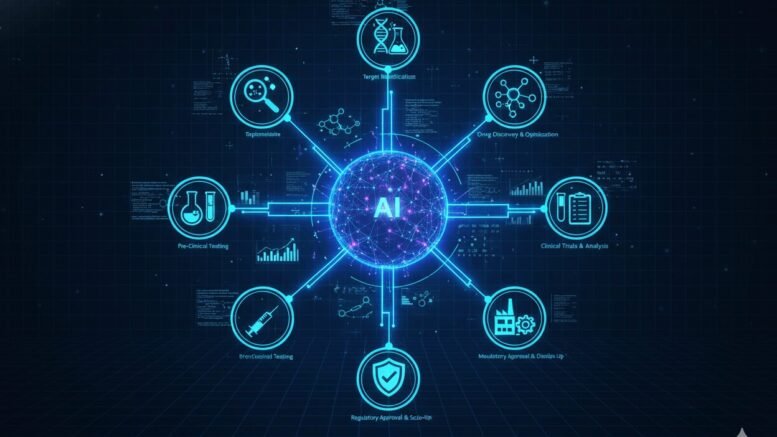
A proactive, artificial intelligence (AI)-driven approach holds promise as an alternative to traditional methods for vaccine development. AI facilitates adaptive trial designs, predictive insights, and streamlined operations. It offers improved efficiency for start-up, including site selection and enhanced patient recruitment and engagement. Ultimately, embracing AI will lead to a responsive, continuously learning vaccine development ecosystem, and result in accelerated access to life-saving vaccines and improved global health readiness.
Challenges in traditional vaccine trials
Traditional clinical trial models are too slow and rigid for today’s changing vaccine development needs. For instance, conventional vaccine timelines can last 5 to 10 years, which is not sufficiently expeditious to respond to emergent health threats.2 Furthermore, there is limited flexibility for trial modification if it becomes clear early on that one trial arm is ineffective, or that protocols should be adjusted to prove greater benefit, ultimately wasting time and resources.
Beyond trial design, there is also a need for speed and agility in study startup. Unlike indications that have relatively static patient populations, such as cancer or chronic conditions, infectious diseases affect a dynamic, shifting group of patients. Additionally, the spread of an infectious disease is often unpredictable. For vaccine trials, this means it is often necessary to track where the disease risk is highest and act quickly to select a site, recruit participants and initiate the trial within an unpredictable window of time. Conventional strategies are not equipped for the rapid response and implementation needed to appropriately react in these situations.
Traditional vaccine trials lead to a lack of adaptability and result in timelines that are untenable in addressing infectious disease. New approaches are needed for designing, executing and delivering vaccine trials swiftly and effectively.
Trial design enhanced by AI
To address some of these challenges, vaccine trials are evolving from fixed plans to adaptive systems that respond and shift based on real-time data and insights. An adaptive trial design provides a plan to prospectively modify elements of the trial depending on the data generated. Such a protocol might, for example, call for refining the sample size, abandoning treatments or doses, or stopping the trial early if success or lack of efficacy is clear. This can increase trial efficiency in a number of ways, such as by reducing the required number of participants, or by halting ineffective arms of a trial sooner.
AI is becoming a pivotal tool for enhancing adaptive trials. It supports human expertise with data-informed recommendations for trial modifications that allow for resource allocation to the most promising vaccine candidate or dosage. By rapidly analysing large trial datasets in real time, AI empowers faster, better-informed decision-making than could be achieved by humans alone. This speed and analytical capability enhances the already advantageous use of adaptive designs.
With responsive systems that learn continuously by leveraging data and expert guidance throughout the course of a trial, AI integration also offers predictive capabilities to optimise adaptive trials. Dynamic AI risk prediction models enable more proactive choices, evolving as trial data accumulates to achieve 85 to 90% accuracy in outcome prediction, compared to the 70 to 75% accuracy of traditional statistical models.3 While trials are ongoing, AI can even evaluate potential outcomes of protocol adjustments and identify which treatment pathway is likely to be the most effective.4 Using this foresight, clinical trials can not merely react to outcomes, but anticipate them and take action early.
Streamlining trial execution
Another significant use of AI in vaccine trials is for enabling more streamlined and efficient clinical trial startup and execution. This is critical for allowing vaccine developers to respond swiftly to new threats and maintain momentum. It also allows developers to avoid delays that can cause significant downstream impacts.
For example, identifying and establishing an appropriate trial site can be a time-consuming process. To accelerate and optimise the site selection process within a limited timeframe, AI can process large amounts of site data to quickly identify those that are the best fit for startup readiness, internal capabilities, geographic location, patient demographics and other clinical trial priorities. As a result, less time is spent assessing and sorting through options, and sites can be selected and onboarded more promptly.
Additionally, the spread of disease can be unpredictable through traditional means, making it challenging to select favorable sites ahead of time. However, advancing AI capabilities are creating enhanced forecasting models. Using a variety of information, including spatial, epidemiological, genomic surveillance and public health policy data, AI models can better predict the behaviour of disease and identify areas that are likely to be hot spots for infection.5 This allows more proactive selection of trial sites, so that they can be prepared to initiate studies when needed.
Recruitment is also a key area in which AI can assist. Even under optimal circumstances, recruiting sufficient numbers of participants can require long processes that significantly delay a clinical trial. Vaccine trials face particular challenges in recruitment, as they typically enrol healthy volunteers, who may be hesitant about the risks involved in a new vaccine. AI can analyse population dynamics, such as historical patterns, demographic factors and clinical characteristics, to identify potential participants likely to enrol successfully and to create targeted recruitment strategies.3 AI can also assess demographics to promote enrollment from diverse populations, which is critical to ensuring that results are representative across all groups. In this way, it provides a tool for finding relevant participants to help speed the recruitment process.
Vision for the future
Incorporating AI in vaccine trials will open doors for health organisations to adapt to dynamic global health challenges effectively. It can speed up vaccine development, such as by enhancing adaptive trials, and as a result improve timely access to life-saving vaccines worldwide. It can provide innovative solutions for operational challenges, such as obstacles to rapid study startup. And it will create a future of vaccine development that supports global preparedness by enhancing vaccine efficacy, as well as responsiveness for future health challenges.
By Dinah Knotts-Keeterle, Vice President, Project Management, Vaccines/Infectious Diseases, ICON
Dinah is currently leading the Vaccines and Infectious Diseases group at ICON, and has 25 years of experience working in the clinical trial industry. She has been with ICON for over 12 years and has held many leadership roles across multiple therapeutic areas including vaccines, oncology, cardiovascular, rare disease, dermatology, CNS, and gastrointestinal.
References
- Wang, Shen, et al. “Emerging and Reemerging Infectious Diseases: Global Trends and New Strategies for Their Prevention and Control.” Signal Transduction and Targeted Therapy, vol. 9, no. 1, Sept. 2024, p. 223. www.nature.com, https://doi.org/10.1038/s41392-024-01917-x.
- “Accelerating Vaccine Trials.” Bulletin of the World Health Organization, vol. 99, no. 7, July 2021, pp. 482–83. PubMed Central, https://doi.org/10.2471/BLT.21.020721.
- Olawade, David B., et al. “Artificial Intelligence in Clinical Trials: A Comprehensive Review of Opportunities, Challenges, and Future Directions.” International Journal of Medical Informatics, vol. 206, Feb. 2026, p. 106141. ScienceDirect, https://doi.org/10.1016/j.ijmedinf.2025.106141.
- Badani, Aarav, et al. “AI and Innovation in Clinical Trials.” NPJ Digital Medicine, vol. 8, Nov. 2025, p. 683. PubMed Central, https://doi.org/10.1038/s41746-025-02048-5.
- Du, Hongru, et al. “Advancing Real-Time Infectious Disease Forecasting Using Large Language Models.” Nature Computational Science, vol. 5, no. 6, June 2025, pp. 467–80. www.nature.com, https://doi.org/10.1038/s43588-025-00798-6.