
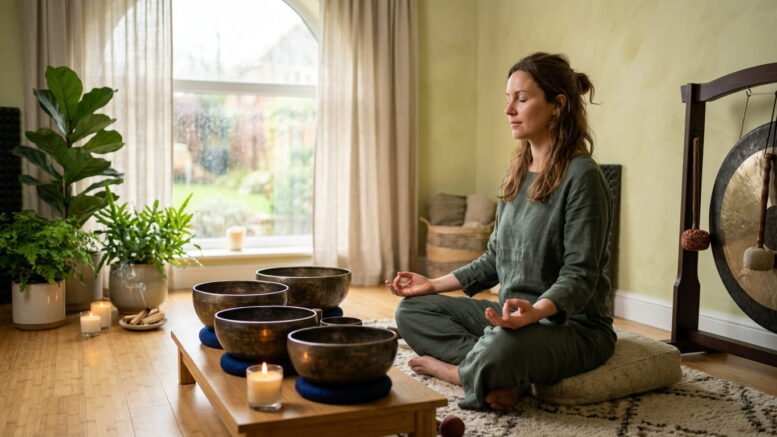
The Convergence of Two Worlds
Mental health care is evolving—but not in the way most people expected. While digital tools like therapy apps and AI-driven mental health platforms are scaling access, they’re not solving a deeper issue: people feel mentally exhausted despite having more “solutions” than ever.
At the same time, ancient practices like sound healing are re-emerging—not as spiritual trends, but as practical tools for stress regulation. This isn’t a coincidence. It’s a response to a gap modern systems haven’t fully addressed.
What Is Sound Healing—And Why Now?
Sound healing utilizes vibrational frequencies – commonly derived from instruments such as singing bowls, gongs or tuning forks – to encourage relaxation and alter mental states. It has its origins in Tibetan and Indian traditions long before it was ever meant to be a clinical form of treatment. It was experiential.
That distinction matters.
Today’s mental health landscape is heavily cognitive: talk therapy, behavioral frameworks, diagnosis-driven models. But not everyone processes stress through language. This is where someone like you steps in because many individuals respond better to sound than they do imagery-based therapies.
Get yourself healing singing bowls, they are some of the simplest ways to introduce yourself into traditional sound practices if ever you do not know where to start or just want to explore how these tools function in day-to-day usages.
The Science: Early Signals, Not Conclusions
Let’s cut through the hype.
Sound healing is not a clinically validated treatment for mental health disorders. The strongest evidence does not yet deem this able to replace therapy or medication.
But to wholly dismiss it is equally non-scientific.
Early research indicates sound-based treatment may be able to:
- Reduce physiological stress markers like cortisol
- Slow heart rate and promote parasympathetic (rest-and-digest) activity
- Induce brainwave states associated with deep relaxation
These effects are not trivial. Chronic stress is a core driver of anxiety, burnout, and sleep disorders. If a method consistently reduces stress, it has adjacent value—even if it’s not a primary treatment.
But here’s the bottom line: the research is promising, not definitive. Anyone claiming otherwise is overselling.
Where It Actually Fits in Mental Health Care
This is where most people get it wrong.
The question isn’t “Does sound healing work?”
The real question is: Where does it fit?
Used correctly, it can complement—not compete with—modern care:
- As a pre-session regulator to help patients enter therapy in a calmer state
- As a non-verbal alternative for people resistant to traditional talk therapy
- As a digital detox tool in an overstimulated environment
Its strength is not depth—it’s accessibility and immediacy.
The Rise of At-Home Integration
Another reason for its growth: control.
People don’t want to rely solely on scheduled sessions or clinical environments. They want tools they can use on demand.
This peaked interest in readily available instruments for individual practice in a self-driven manner. For instance, the subjective ear for sound-based techniques that can be experimented with at home when using curated selections such as a singing bowl set oriented towards meditation and relaxation without specific training.
But if we are frank — that is also the ground of abuse.
Owning the tool doesn’t mean understanding the method. Without proper expectations, people start treating supportive practices as primary solutions. That’s where things break down.
The Real Problem: Wellness Without Discipline
The biggest threat to sound healing isn’t skepticism—it’s overhype.
The wellness industry has a pattern:
- Take an ancient practice
- Strip its context
- Package it as a quick fix
Sound healing is heading in that direction. If it becomes another “buy this and fix your anxiety” trend, it loses credibility—and rightfully so.
A Smarter Way Forward
There is a legitimate role for sound healing in modern mental health—but only under strict conditions:
- It must be positioned as supportive, not curative
- It should be integrated alongside evidence-based care
- It requires user education, not just product access
Clinicians need to stay open—but critical.
Consumers need to stay curious—but skeptical.
Anything else turns this into noise—literally and figuratively.
Final Thought
The growing interest in sound healing isn’t really about sound. It’s about dissatisfaction with rigid, one-dimensional approaches to mental health. People are looking for something that feels immediate, physical, and human—not just analytical.
That demand is real. But meeting it requires discipline, not trends. That is because in mental health, the price of a belief that feels good — but fails to stand the reality test — is just too high.