
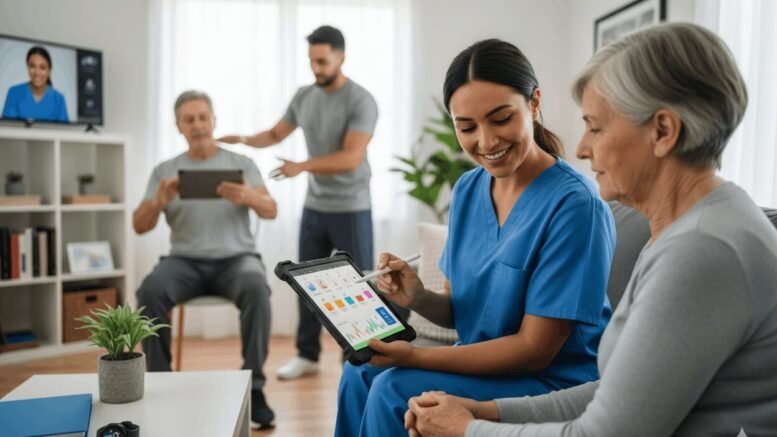
At one of our recent digital inclusion pop-up hubs in Leeds, we helped a man who had been living with high blood pressure for years. He could not get a GP appointment and when we got talking, it turned out he had never had an email address in his life and had never had much reason to want one until the NHS quietly started asking for it. One of the team sat down with him and stayed there for two hours, setting up an email account, downloading the NHS App, going through it with him screen by screen and eventually helping him request the appointment he had been trying and failing to get for months. Two hours of somebody’s time. That was what had been standing between him and care he was entitled to all along.
Nobody had decided to exclude him, and I want to be clear about that, because there is no policy anywhere saying that people without an email address should wait longer than everybody else. I have never met a single person working in NHS digital teams who would want that outcome, but what happened was far more ordinary and much harder to fix. He came up against some small, sensible-looking requirements, none of which would register as an obstacle to most of us, but which meant for him it was a barrier to the care he needed.
I have started calling these ‘micro exclusions’, and once you notice them you can’t stop. Registering for a digital health app means having an email address to receive the verification code, which means a phone that is charged, has enough data and is not currently in use by your daughter. If you get that far there is the data to pay for, the text that is too small to read, and the session that times out and sends you back to the beginning. At which point most people ring the surgery at 8am as they always have. Taken one at a time, none of these are huge issues but it’s when they stack up that the damage is done. And this is worse for the people with the most to gain from getting through, such as older people, people managing long-term conditions and people who were never confident with any of this to begin with.
None of which is an argument against the NHS App. It has made life easier for millions of people and is fast becoming the front door to healthcare, in fact Helen Clifton (Executive Director of Products and Platforms at NHS England) discussed transitioning the NHS App into a proactive “health companion” with AI-powered triage services. It will be the place where appointments are booked, prescriptions ordered and practices messaged. My concern is with the people left behind, because what used to be a difference in convenience has turned into a difference in access, and some people now queue in person for an appointment that others book in seconds from the sofa.
The hubs we run with the team at Leeds Community Healthcare NHS Trust are an attempt to do something about that. They are free, they pop up in ordinary community spaces where people were going anyway, and anyone can walk in without a referral or an appointment and sit with someone for as long as it takes. Two things have surprised me. The first is how rarely the barrier turns out to be the one you would have guessed, which is why the help has to be one-to-one and cannot be a leaflet or a group session. The second is how often people apologise for needing help, as though the difficulty were a personal failing rather than a design decision taken in a room full of health bods, they were never invited into.
Digital inclusion appears in almost every strategy document I read but it’s not in any commissioning rounds, it is not in the GP contract, it is not a trust performance measure, and nobody is held to account for it at the end of the year. It runs on goodwill, on the odd pot of transformation funding and on staff making time they were never given, which is a thin foundation for something the whole shift to digital now rests on.
About the author
Emma Raftery is Partnerships Lead at The Equity Charter and Marketing Director at Aire Logic. She helps run free digital inclusion pop-up hubs in Leeds with Leeds Community Healthcare NHS Trust, and will be speaking about this work at the Digital Health World Congress in London on 23 November.