
In April, MHRA and NICE announced a new joint pathway to expedite patient access to medicines by streamlining licensing and value assessment. This pathway synchronises NICE technology appraisal decisions with MHRA regulatory decisions. In practice, this means companies register early PharmaScan which is the national horizon scanning database and confirm at NICE topic selection stage that they can meet coordinated timelines, then submit to both bodies, resulting in a 3-6 month reduction in waiting times for NHS patient access.
While welcome news, this streamlined process does not extend to medical technologies. The disparity is not deliberate but creates challenges for healthtech companies who have to navigate a slower and more fragmented route to market compared to their pharmaceutical counterparts.
The pathway offers clear benefits to pharmaceutical companies. For example, NICE publishing its technology appraisal guidance at the same time as MHRA marketing authorisation closes the gap between a medicine being licensed and it actually being funded and available on the NHS. Timelines become far more predictable too, as the priority scheduling from NICE and coordinated milestones give companies a clear, agreed structure to plan clinical, regulatory and commercial activity around. Furthermore, commercial benefits arrive sooner, as earlier entry into the NHS means a longer period before the Voluntary Scheme for Branded Medicines Pricing Access and Growth refund starts to apply. More broadly, this pathway will incentivise large global pharmaceutical companies to sell into the NHS, in turn speeding up NHS adoption of new medicines over time.
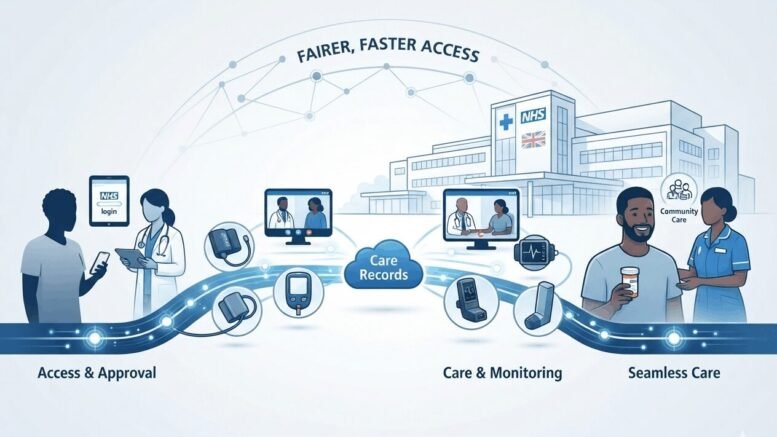
Conversely, healthtech suppliers, even after obtaining positive NICE guidance and strong clinical evidence, still face slower and patchier routes-to-market for widespread adoption. Market access leads have to tackle MHRA regulation, NICE guidance, supply chain tenders, changing Government guidance for procurement, and varying trust procurement methodology without a coordinated timeline to work towards. Coordinating milestones between MHRA regulatory clearance and NICE evaluation would give healthtech the same clear route from approval to deployment that medicines now have, rather than the current pattern where a product can be approved yet sit unused for months or years while individual trusts and Integrated Care Boards make their own decisions. The UK would become a more favourable place to develop and launch healthtech.
On a national level, a joined-up pathway would help to directly address the “postcode lottery”. At present, whether a patient gets access to medical technology often depends more on where they live and which local system has chosen to fund it than on their actual condition. A consistent national pathway would mean that access is driven by clinical need, so a patient in one part of the country has the same chance of receiving an effective digital tool as a patient anywhere else.
The NHSE/DHSC merger is an opportunity for streamlining approvals. But other ways in which the MHRA and NICE can create a more streamlined process are agreeing on a shared entry point for digital and medical technologies, comparable to UK PharmaScan, so developers can register products early and both organisations gain visibility of what is coming through the system well ahead of launch. NICE would then need to set out clear, published criteria for which digital tools and devices qualify for priority scheduling, much as it currently prioritises medicines coming through ILAP (Innovative Licensing and Access Pathway) or Project Orbis, so companies know from the outset whether they are eligible. MHRA and NICE would also need to agree on coordinated milestones between regulatory clearance and health technology assessment, so that evaluation work can begin well before a product reaches the market rather than starting only once it is already approved. Finally, offering integrated advice schemes for healthtech products, in the same way it is already offered for medicines, would let developers design their evidence generation and evaluation plans to meet both regulatory and NICE requirements from the start, reducing delay and rework later in the process.
For patients, the stakes are not abstract. When an approved healthtech product sits unused while trusts and ICBs deliberate, real people wait longer than they should for tools that could ease their symptoms and the postcode lottery only sharpens the unfairness, since two patients with the same clinical need can face entirely different odds simply because of where they live. A remote monitoring device that lets someone with a long-term condition stay safely at home only helps if patients can actually get hold of it. A joined-up national pathway would mean access follows clinical need rather than geography, deliver the technology sooner and remove some of the anxiety of not knowing.
By Nick Lansman, CEO and Founder of the Health Tech Alliance (HTA)