
FDA authorisations of AI-enabled software as medical devices (SaMDs) have increased significantly. Over 50% of FDA authorisations have occurred since 2022 with the majority (76%) in the field of radiology. We trace this emerging technology’s development in five foundational blocks reflecting its evolution and likely future progression. The early blocks focus on AI interpreting a single type of medical data, such as IVD assay results or medical images. Later blocks are more sophisticated, integrating multiple data sources to support personalised, preventative and treatment-directing care. Collectively the blocks provide a high level framework showing the progress of AI in medicine.
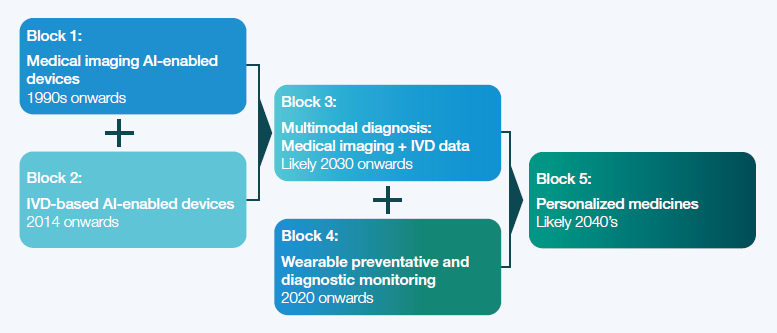
Building blocks of AI-enabled SaMD
Building blocks of AI-enabled SaMD
AI-enabled SaMD can be categorised in five blocks:
- Medical imaging-based AI-enabled devices
- IVD-based
- Multimodal diagnosis using imaging and IVD data (integrating blocks 1 and 2)
- Wearable-based preventative and diagnostic monitoring
- Personalised medicine based on blocks 3 and 4
Given radiology’s dominance in AI-enabled SaMD to this point it seems apt to use the terminology for radiological assessment: CADt, CADe and CADe/x. These reflect the AI algorithm’s ability to do the following:
- Triage (t): analyse and highlight a piece of source data for review by physician
- Detection (e): analyse and flag a section or sub-set of source data
- Diagnosis (x): analyse source data and produce a single outcome or conclusion
- NEW Treatment plan (p): combine source data inputs with diagnostic decisions to provide a single treatment plan
Block 1: AI diagnosis from radiology devices
The rate of FDA authorisations for all three categories of radiology devices (CADt, CADe and CADx) increased moderately between 1998 and 2018. From 2019 there was a significant increase in authorisations coinciding with an FDA initiative to update guidance for AI/Machine Learning (ML) algorithms within SaMD applications. The increased growth rate continued from 2020 to 2025.
Authorisations in other regions
The EU Medical Device Regulation (MDR 2017/745) has led to widespread CE marking of AI-enabled radiology tools. Along with chest imaging solutions and mammography screening tools, general medical and cardiovascular imaging AI platforms have also been authorised. For example Canon Medical’s CT VScore+ which is designed to detect and quantify calcified legions in non-contract cardiac CT scans (CADe/x). Another notable approval is Siemen’s MAGNETOM MRI systems (CADe) to assist with structural imaging. These approvals signal a shift toward integrated AI in European clinical practice.
China’s NMPA and Japan’s PMDA have authorised dozens of AI radiology tools under high risk classifications. NMPA approvals often target high-volume screening needs. A good example is Deepwise’s mammography software (CADe/x) which became a primary AI-enabled tool for breast cancer detection and classification in the Chinese market. Japan’s focus has been on integrating AI into clinical workflows through its SaMD framework. There is a trend toward multimodal diagnostic support across the APAC region.
Block 2: AI-enabled IVD devices
As of the last quarter of 2025 there is a limited number of AI-enabled in-vitro diagnostic (IVD) device and testing assays. However, there are key examples of FDA authorised IVDs that use AI for detection, diagnosis and guidance on patient treatment regimes. The earliest are from 2013 when two companies, Bruker and Vitak, developed AI-enabled algorithms for use with their Mass Spectrometry equipment to detect the presence of Gram-negative bacteria within bacteria colonies cultured from human samples. This early example demonstrates AI’s ability to process large volumes of data to detect a medical condition. The late 2010s and early 2020s saw more significant advances of AI use to complement traditional IVD assay techniques. These tools are used to detect specific medical conditions by quickly processing large amounts of nucleic and ribonucleic acid sequences.
To our knowledge the first examples of AI-enabled devices offering significant guidance on patient treatment are the 2023 and 2025 FDA authorised technologies from Tempus Labs and Geneseeq Technologies. These technologies pair AI with Next Generation Sequencing (NGS) of DNA from human samples of patients with known cancer diagnoses of malignant neoplasm. They develop tumour mutation and cancer profiles for patients by performing a complex analysis of patient DNA to detect single nucleotide variants (SNVs), insertions or deletions. This gives the treating physician insights into patient treatment regimens, allowing them to identify qualified individuals who may benefit from targeted.
With the expansion of AI’s capabilities, we anticipate a proportional rise of sophisticated AI models that rapidly process and form conclusions from state-of-the-art IVD assays. This could make personalised medicines more widely available.
Block 3: Multi-modal diagnosis using radiology and IVD
To date we are not aware of any known authorisations compiling multimodal analysis of IVD and imaging datasets to inform patient treatment. For now, this remains the realm of the physician.
Block 4 AI-enabled wearable devices
There has been a rapid advance in wearable devices with AI-enabled arrhythmia detection, sleep apnoea risk evaluation and decision support tools for diabetes management. They offer obvious advantages to both physicians and patients in their ability to gather health information outside of clinical settings and without impacting the users’ daily routines. The PeraWatch, authorised in 2019, was designed to measure and quantify vital signs and provide warning states to healthcare professionals. Larger consumer platforms adopted AFib-screening functionality with Apple, Samsung and Fitbit smartwatches featuring irregular rhythm detections. Apple and Samsung have also developed sleep apnoea screening functions to identify users who may be at risk. These consumer wearables are not intended to diagnose or guide treatment but instead to act as early awareness, encouraging users to seek further medical evaluation.
DreaMed Advisor Pro is a software-based clinical decision support tool that analyses data from wearable diabetes devices such as continuous glucose monitors (CGMs) and insulin pumps. FDA-cleared in 2019, it generates insulin-therapy adjustment recommendations for healthcare professionals managing patients with Type 1 diabetes. This is the only FDA-cleared AI-enabled SaMD providing treatment recommendations for patients with pre-existing diagnosis.
Where to next?
Reviewing the progression of AI-enabled medical technologies shows a consistent trajectory from detection, to triage, diagnosis and ultimately towards treatment guidance. Increasingly capable AI systems will progress beyond identifying conditions to shaping individualised treatment strategies. Conventional diagnoses and treatment plans typically integrate multiple data sources such as patient history, symptoms and vital signs. Multimodal data is even more essential for rarer or more complex diseases. Cancer care is likely to be one of the first areas to adopt an approach that reflects block 3, combining data from radiology (block 1) and IVD (block 2) to generate both a diagnosis and personalised treatment plan. We anticipate the first FDA clearances for block 3 type AI-enabled SaMD around 2030-2032. Block 5 is the most advanced vision for AI in medicine: integrating radiology, IVD and wearable data into a unified platform to offer personalised, preventative and diagnostic guidance with minimal clinician input. This category is likely one or two decades away due to its complexity and biological variabilities.
With the acceleration of AI-specific semiconductor technologies, computation is no longer a limitation. Instead, the bottlenecks for blocks 3 and 5 are likely to be large-scale, diverse, HIPAA-compliant data acquisition and rigorous clinical validation which are required for higher-risk diagnostic and treatment planning tools. Other barriers include clinical trial designs, robust change management frameworks and evidence of real world performance stability. Finally, it will be crucial to get buy-in from treating physicians, clinical trial participants and patients when new AI-enabled SaMDs are available.
About the authors
Devin Ridgley PhD, Director, Medical Devices and Diagnostic Research
Devin Ridgley is a Director of Project Management for ICON Medical Device and Diagnostic Research (MDDR) business unit and is responsible for providing oversight of sponsor-MDDR clinical studies. He has 15 years’ experience within clinical medical research and biotechnology engineering applications within academia, private industry, and clinical research organisations.
JoAnne Bronikowski, BSCS, RAC, Senior Manager, Regulatory Affairs
JoAnne has over 30 years of software experience, starting with supervisory control and data acquisition (SCADA) systems followed by over 25 years of medical device experience in software development, product/program/project management, quality assurance, and regulatory affairs. JoAnne has worked with various systems including advanced clinical decision support, oxygen delivery, drug delivery (inhalation, infusion, injection, ingestible), imaging, perinatal / fetal monitoring systems, and clinical information.