
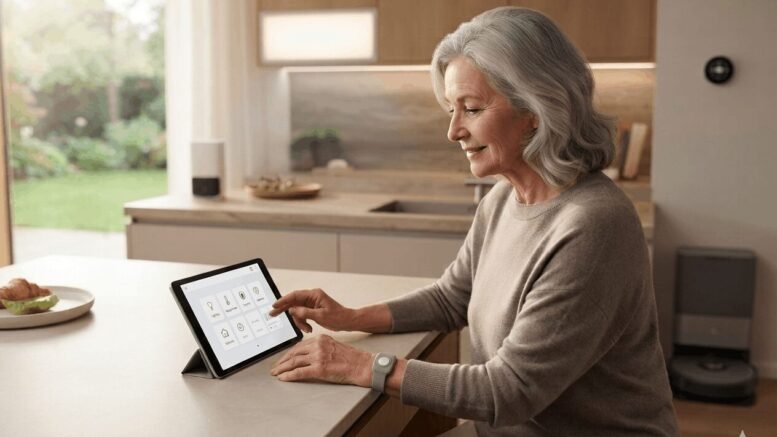
Enabling people with health and care needs to live independently has been a goal in the UK for decades. Over time, technology has been introduced to help to achieve this, supporting health and safety to enable people to live at home for longer. The potential is there, but not yet fully realised, to ease the pressure on waiting lists, workforce capacity and constrained budgets across the health and social care system.
Just as importantly, home is where many individuals want to remain. Being in familiar surroundings supports independence, dignity and overall wellbeing, with proven benefits on both physical and mental health.
A significant challenge seen by technology enabled care firms across the UK, is the limited knowledge of the possibilities presented technology to help individuals to maintain independence at home. Shantelle Million-Lawson, Head of Tunstall 365 at Tunstall Healthcare, discusses how the future of independent living should not be shaped by a single piece of technology, but by combining new and existing smart technologies, along with support, to enable people to live the lives they want to live .
For years, technology-enabled care (TEC) has been designed around responding to calls, typically through a monitoring centre that’s alerted when a wearable device is pressed or a sensor activated. However, as the British population continues to live for longer, the industry must look to the future to keep people safe and well.
It’s clear that integrated smart technology has an increasing presence in everyday life, from smart speakers to connected home devices, UK adoption of at home technology is increasing – even outpacing the US according to research from The Infinite Dial UK 2025, with more than 45% of households in the UK own at least one smart speaker.
As the telecare industry shifts from analogue to digital, there’s a clear opportunity for health and care devices to integrate with these devices. The challenge doesn’t lie in the lack of technology, but in ensuring it is used to best effect.
Integration is the next frontier
Conversations around smart home technology tend to centre around the introduction of new devices entering the market, yet many homes already contain a variety of connected technologies.
Individual devices provide isolated information while connected systems create meaningful insight. When data from multiple sources can be viewed collectively, organisations gain a far deeper understanding of an individual’s health and changing needs.
Where some people are reluctant to use a telecare alarm system because it feels like a sign of frailty, they may feel more comfortable using a smart speaker or smart plugs, which over time may act as a gateway to more specialist technology.
For health, housing and social care providers, interoperability is increasingly one of the sector’s biggest priorities and a key enabler of digital care transformation. Integrated platforms that connect consumer technology with care systems enable professionals to make better-informed decisions while reducing duplication and improving efficiency.
The next stage of innovation won’t come solely from developing new technologies. It will come from ensuring existing technologies can work seamlessly together through interoperable platforms, connecting health, housing and care.
Modernising technology-enabled care
The next generation of TEC must move beyond standalone alarms towards flexible, connected ecosystems that adapt as needs change. These ecosystems should harness the ability of specialist care technologies into the smart devices already present in people’s homes, creating a more connected and personalised approach to independent living.
Artificial intelligence, predictive analytics and automation all have important roles to play, but only when supported by integrated infrastructure and high-quality data. Without that foundation, new technology risks adding complexity rather than improving care.
Importantly, technology should enhance human care, not replace it. Its value lies in giving people greater confidence to live independently, providing reassurance to families and enabling professionals to focus on delivering person-centred support.
It needs devices, apps and care systems that can actually work together, instead of each one operating on its own separate island. It needs well-managed data so the predictive tools are something people can trust using. Most importantly, it needs to be built together with the people who’ll actually use it, testing ways of working before rolling it out everywhere, and making sure funding covers not just the equipment itself but the work of making it all fit together to the benefit of the individual using it and their circle of care.
What the sector needs to do next
The technology needed to support more proactive, preventative care already exists. The challenge now is creating the infrastructure that allows it to work in harmony.
As organisations continue to invest in digital systems, they should consider how those investments can deliver greater value through interoperability. Bringing together data from smart home devices, technology-enabled care solutions and health, housing and care systems into a single connected platform can unlock deeper insights, enable earlier intervention and support delivering personalised care.
A truly interoperable platform has the potential to transform fragmented information into a complete picture of a person’s wellbeing, helping providers identify changing needs before they become crises while enabling staff to deliver care where and when it is needed most.
As the sector looks ahead, success will depend not on introducing more standalone devices, but on creating the infrastructure that allows existing technologies to work seamlessly together.
To find out more about Tunstall Healthcare, please visit: www.tunstall.co.uk
By Shantelle Million-Lawson, Head of Tunstall 365