
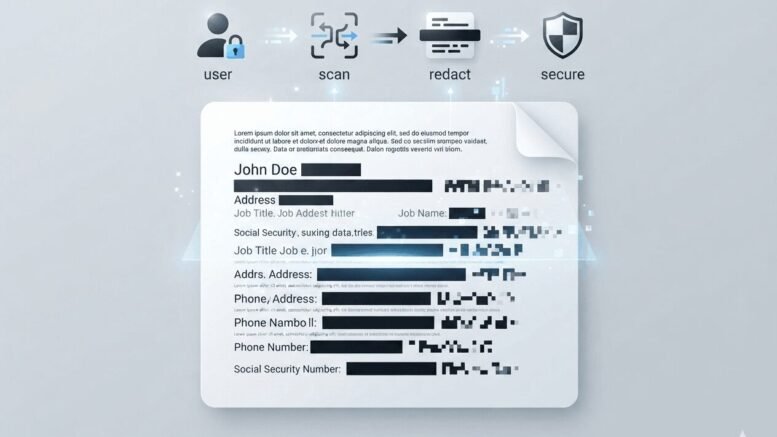
Think about the last time you filled out a form — at a doctor’s office, a bank, a government agency, or even a job application. You provided your name, your address, your date of birth, perhaps your social security number or financial account details. You handed over that information trusting that the organization receiving it would handle it with appropriate care, share it only when necessary, and protect it from exposure that could cause you genuine harm. Now multiply that single interaction by millions — across hospitals, law firms, insurance companies, schools, government agencies, and financial institutions — and you begin to grasp the extraordinary volume of sensitive personal information that flows through organizational systems every single day. Managing that information responsibly, particularly when documents containing it need to be shared, disclosed, or published, has become one of the most critical and complex challenges in modern information governance. It is precisely this challenge that PII redaction tools have been developed to address — and the organizations that take this challenge seriously are better positioned legally, ethically, and operationally than those that don’t.
Understanding PII: More Than Just a Name and Address
Before exploring how redaction tools work and why they matter, it’s worth establishing a clear understanding of what personally identifiable information actually encompasses — because the scope is broader than many people initially assume.
At its most basic level, PII is any information that can be used to identify a specific individual. The obvious examples — name, address, phone number, social security number, date of birth — are what most people think of first. But the definition extends significantly further in both regulatory frameworks and practical privacy risk terms.
Financial account numbers, credit card details, and bank routing numbers are PII. Email addresses and IP addresses qualify in many regulatory frameworks. Biometric data — fingerprints, facial recognition data, voice patterns — is PII. Medical record numbers, health insurance identifiers, and diagnosis codes are PII. Driver’s license numbers, passport numbers, and other government-issued identifiers are PII. Even combinations of information that seem innocuous individually — a job title combined with an employer name and approximate age — can become identifying when pieced together, a phenomenon that privacy professionals refer to as the aggregation problem.
This breadth means that PII appears in an extraordinary range of document types across virtually every organizational function. It’s not confined to dedicated personnel files or patient records. It appears in email threads, meeting notes, contracts, invoices, court filings, research datasets, inspection reports, and countless other document categories that organizations create, receive, and share as part of their normal operations.
The Legal Landscape Driving PII Protection
The regulatory environment surrounding personal information protection has grown dramatically more complex and more consequential over the past decade, creating powerful legal incentives for organizations to take PII management seriously.
The General Data Protection Regulation — GDPR — established sweeping privacy rights for individuals in the European Union and imposed significant obligations on any organization worldwide that handles the personal data of EU residents. Penalties for non-compliance can reach four percent of global annual revenue or twenty million euros, whichever is higher — figures that have focused organizational attention on privacy compliance in ways that no previous regulatory framework achieved.
In the United States, a patchwork of federal and state regulations creates overlapping obligations that vary by sector, state, and data type. HIPAA governs the protection of health information with some of the most detailed and strictly enforced requirements in the privacy landscape. The California Consumer Privacy Act and its successor legislation have established strong privacy rights for California residents. Financial sector regulations govern the protection of customer financial information. Education privacy laws protect student records. Dozens of state breach notification laws create specific requirements for how organizations must respond when protected information is improperly disclosed.
Collectively, these regulations create a legal environment in which the improper exposure of PII is not merely a reputational risk — it is a concrete legal and financial liability that organizations of every size and sector need to manage actively and systematically.
Where PII Redaction Becomes Essential
The need for PII redaction arises in a specific and important context: when documents containing personal information need to be shared, disclosed, or published, but the personal information they contain must be protected in the process. This situation arises more frequently and in more organizational contexts than most people initially recognize.
Legal discovery is one of the most demanding redaction contexts. When litigation requires the exchange of documents between parties, vast quantities of organizational records — emails, contracts, financial records, communications — must be reviewed and produced. These documents routinely contain PII that must be identified and redacted before production, and the volumes involved in complex litigation can be staggering — millions of pages reviewed under tight legal deadlines.
Freedom of information and public records requests submitted to government agencies create redaction obligations at massive scale. Agencies must disclose records that are subject to public disclosure requirements while simultaneously protecting the personal information of private individuals contained in those records. This simultaneous disclosure and protection obligation is precisely the challenge that redaction addresses.
Research and data sharing in healthcare, academia, and the social sciences requires the de-identification of datasets that contain personal information before they can be shared with researchers, published in studies, or used in ways that extend beyond the original collection purpose. Effective de-identification — which goes beyond simply removing names to address the full range of potentially identifying information — is a sophisticated PII redaction challenge.
Internal document sharing creates redaction needs that organizations sometimes overlook. When HR records are shared with managers who don’t need access to all contained information, when legal files are distributed across a broader team, or when vendor documents containing customer information are processed by multiple departments, internal PII protection requires the same careful attention as external disclosure.
How PII Redaction Tools Transform the Process
This is where purpose-built PII redaction tools become not merely helpful but genuinely essential for organizations operating at any meaningful scale. The alternative — manual review of every document by trained staff — is increasingly untenable given the volumes involved, the complexity of what must be identified, and the very real consequences of errors.
Modern PII redaction tools apply a combination of pattern recognition, natural language processing, and in more advanced systems, machine learning capabilities to systematically identify personal information across documents. They recognize structured PII — formatted identifiers like social security numbers, phone numbers, and credit card numbers — through pattern matching. They recognize unstructured PII — names, addresses, contextual personal references — through natural language understanding that goes beyond simple keyword matching to comprehend the meaning and context of language in documents.
The speed advantage alone is transformative. A document review that might take a trained human reviewer an hour to complete manually can be processed by an automated system in seconds, with consistent application of the same identification logic regardless of document length or complexity. This speed advantage compounds dramatically at scale — what would require weeks or months of manual review can be accomplished in hours or days.
Consistency is the second major advantage. Human reviewers are subject to fatigue, distraction, and the natural variation in attention that affects all people performing repetitive tasks over extended periods. Automated PII identification applies the same logic to the ten-thousandth document as to the first, without the degradation in accuracy that inevitably affects human review at scale.
Audit trail documentation is a third critical capability. When redaction decisions are challenged — as they frequently are in legal and regulatory contexts — having a complete, timestamped record of what was identified, what was redacted, and under what authority is essential for defending the organization’s approach. Manual processes often lack this documentation. Dedicated redaction tools build it automatically.
The Human Judgment That Technology Still Requires
Even the most sophisticated PII redaction tools are not fully autonomous solutions, and organizations that understand their appropriate role get better outcomes than those that treat them as set-and-forget technology.
The most effective deployment of PII redaction tools combines automated identification and processing with human oversight for the judgment calls that technology cannot reliably make. Whether a specific piece of information requires redaction in a specific context often depends on legal interpretation, the specific regulatory framework applicable to the document type, and situational knowledge about the purpose of the disclosure. These nuanced determinations benefit from human expertise — freed from the burden of systematic identification work by automation that handles the high-volume, pattern-based aspects of the task.
This collaboration between human expertise and AI capability represents the current state of the art in responsible PII management — and it reflects a broader truth about technology in the information governance space. The goal is not to remove humans from the process but to focus their limited time and attention on the decisions that genuinely require human judgment, while technology handles the systematic work that scale makes humanly impossible.
Organizations that get this balance right — deploying capable PII redaction tools with appropriate human oversight and clear governance policies — are building an information management capability that protects individuals, satisfies regulators, and supports the trust that every organization ultimately depends on to function effectively in a world where data is both a fundamental asset and a profound responsibility.