
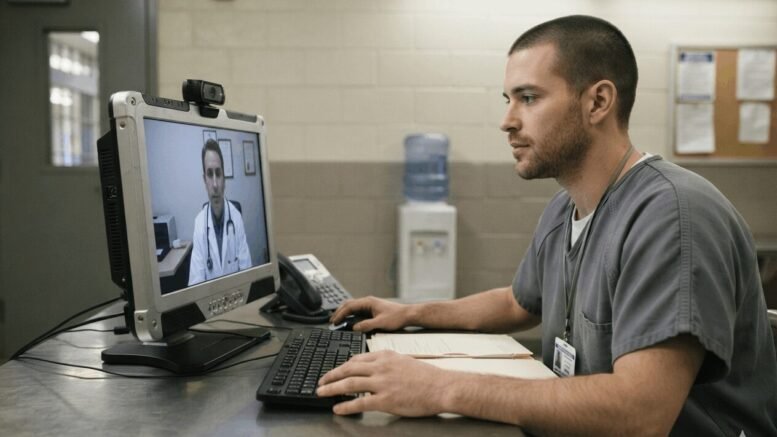
Access to specialty care and continuity of care after release are often treated as separate problems within correctional healthcare systems. In practice, the two are closely linked. When a specialty consult requires transporting an incarcerated individual offsite, the cost and logistics can delay treatment long enough for a condition to worsen, and when that same gap in access follows a person through re-entry, it can undercut care after release too.
Safety Net Connect has spent over a decade building asynchronous eConsult programs that connect correctional health systems with specialists, including a program in LA County that has supported more than 15 correctional facilities since 2014. In this Q&A, Keith Matsutsuyu, CEO and co-founder of Safety Net Connect, shares his perspective on why traditional telehealth models fall short in corrections, how eConsult changes the economics and speed of specialty care, and what health systems outside of corrections can learn from an environment built around some of the toughest constraints in healthcare delivery.
-
Why is specialty care access particularly difficult to deliver in correctional healthcare settings?
By its nature, access to specialty care services has traditionally required the incarcerated individual to be transferred offsite to a secure location, whether a hospital or a clinic, and that typically means a minimum of two guards accompanying that person. The cost and logistics of that transfer add to the challenge of providing more immediate care or treatment, which can allow a condition to worsen and raise the level of care, and the cost, required down the line.
Federal data puts history of mental illness at roughly 37 percent of the prison population, and NIDA estimates substance use disorder rates as high as 65 percent. The people who need specialty input most often sit inside the delivery model least equipped to provide it.
-
What are the operational and financial implications of relying on patient transport for specialty care?
The implications are significant. There is a higher cost per episode, and potentially higher costs still if care is delayed. There is also the logistical challenge of scheduling MD availability for an in-person visit around custody schedules.
In LA County, we have supported 15+ correctional facilities since 2014, completing more than 22,000 specialty consults and avoiding roughly 5,000 transports. Every one of those avoided transports is guard hours, a vehicle, and a security exposure the facility no longer has to absorb.
-
Why have traditional telehealth approaches, such as video visits, had limited impact in these environments?
Traditional telehealth in this space has largely meant televideo visits. Those are more cost efficient than transporting a patient for a face-to-face visit, but they do little to maximize a specialist’s time. A televideo visit still has to be scheduled during standard operating hours, still takes as long as a face-to-face visit, and still limits how many patients a specialist can reach. Access is also limited to whichever specialists happen to be geographically available to that site.
A video visit still moves the patient inside the facility as well. There is an escort, an exam room, a scheduled slot, and custody staff tied up either way. Asynchronous review removes the appointment itself.
-
How does asynchronous eConsult change the model for delivering specialty care in corrections?
eConsult doesn’t limit the specialist to a locale or region, and it doesn’t need to happen during standard operating hours. Most importantly, it significantly increases the number of patients a specialist can impact. A televisit typically takes 20 to 30 minutes per patient, but an efficient specialty reviewer can process 6 to 8 eConsults in an hour.
-
What impact can this approach have on continuity of care during reentry into the community?
eConsult can have a significant impact on continuity of care for reentry. The information and recommendations a specialist provides, including specific linkage for post-release care, can help the community physician engage the patient more quickly and effectively once they’re back in the community. That kind of immediate engagement improves the patient’s health outcomes and reduces the potential for recidivism.
The policy environment is starting to support this directly. Eighteen states have approved Medicaid Section 1115 re-entry demonstrations, which allow coverage of services up to 90 days before release, and as of January 1, 2026, federal law requires states to suspend rather than terminate Medicaid enrollment during incarceration. A specialist record built before release gives the receiving community provider something concrete to act on the day that person walks out.
-
How can correctional systems ensure they are meeting community standards of care?
eConsult works as a communication platform beyond specialty care advice alone, helping guide and reinforce community standards of care. In a lot of cases, it becomes a learning tool for the clinical resource using the specialist’s input.
It also leaves a written record. Every eConsult produces documentation in the chart, and when a system needs to show an accreditor, a court, or a monitor that its care meets community standards, that record is the evidence.
-
What broader lessons can health systems learn from correctional care when designing digital health strategies?
Health systems typically have specialist resources and access that go untapped. Leveraging eConsult opens up opportunities to serve the correctional population, and it creates a necessary link for data sharing ahead of any case that might eventually need to be seen at the health system itself. Combining televisits with eConsult creates a virtual model of care that makes delivery more efficient and gives systems options for where care is most efficiently delivered.
Corrections is the hardest environment digital health operates in. There are no patient devices, movement is controlled, and every process goes through security review. A model that holds up there wasn’t built on optimistic assumptions. Health systems designing for rural or low-connectivity populations are really solving smaller versions of the same problem.
By Keith Matsutsuyu, Safety Net Connect