


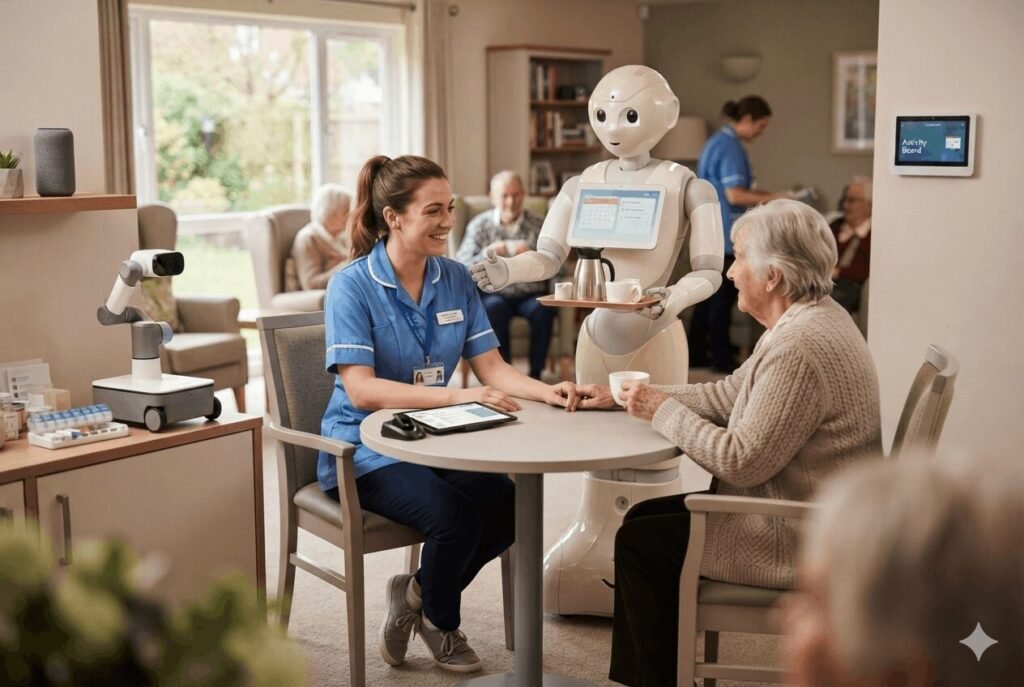
The social care sector is under sustained pressure. An ageing population, the increasing complexity of care needs and ongoing workforce shortages are placing strain on providers. Long waiting times and overstretched teams are familiar concerns across the sector. The question is no longer whether technology has a role, but how robot carers in social care can support a more sustainable model of care.
Artificial intelligence is already reshaping parts of care, while robotics may play a more significant role over time. The idea has recently entered popular culture through the BBC comedy Ann Droid, in which Diane Morgan plays a second-hand humanoid robot brought in to support an older woman at home. While the premise is deliberately comic, it reflects genuine questions about how people may respond to robots entering care settings.
The phrase “robot carers” may evoke science fiction imagery or anxieties about cold, automated environments. But the more important question is what role we want robotics to play and how we ensure it supports, rather than displaces, human care.
Crucially, the debate around AI and robotics in care is too often framed as a choice between people and machines. That is the wrong starting point. A human still needs to be at the centre of care. Much of care is hands-on, relational and deeply human. If robotics can assist with medical alerts, medication reminders, lifting support, domestic tasks or routine checks, it will support carers rather than replace them. AI is making some of these applications more feasible, while robotics may extend them further over time.
Reducing the administrative burden
To understand where robotics and advanced AI will take us we must first look at where the care sector stands today. Despite widespread digitisation across other parts of healthcare, many care providers still rely on a number of manual processes. These steps remain embedded across day-to-day workflows, adding administrative effort and making information harder to capture, share and use consistently.
Automating these workflows can significantly reduce time spent on administrative tasks. This benefits back office administration and can give frontline care workers more time. Carers enter the profession to deliver meaningful, face-to-face support. Instead, they are often required to spend a lot of time completing documentation, filling out forms or navigating fragmented, disconnected software systems.
Simplifying these processes is important. For example, a large proportion of the modern care workforce speaks English as a second language. By deploying intelligent AI tools like automated transcription and voice activated scribing, technology can bridge language barriers, capture accurate shift notes instantly and allow carers to keep their eyes on the client, rather than a screen.
Navigating the big three: compliance, quality and efficiency
Every care provider, regardless of size, is balancing three core priorities: compliance, care quality and efficiency.
Regulatory and compliance expectations continue to increase. Providers need clear and comprehensive records, both to support good care and to demonstrate that requirements are being met. Frontline managers cannot see everything that happens in the field, which can make it difficult to identify patterns, learn from events and reflect that information in care planning.
Technology can help by bringing together information from areas such as nutrition, hydration and medication management, where changes or gaps may indicate a need for closer attention.
However, compliance should not come at the cost of care quality. Used well, software can reduce administrative work, improve access to relevant information and give care teams more time to focus on providing exceptional care for every person.
The shift from reactive to proactive care
Beyond driving operational efficiency, AI may also help care services identify and respond to emerging risks earlier. Too much care remains reactive. Information is often acted on only after a symptom emerges, an incident occurs or a person experiences a major deterioration. The shift from reactive to proactive care is particularly important. Rather than waiting until a symptom emerges before acting, we need to place greater emphasis on early detection and prevention.
Every day, care services capture large amounts of information about people’s health, support, experiences and outcomes. Too often, that information remains fragmented across separate systems and is used mainly for retrospective reporting.
The greater opportunity is to connect those sources and use them to support earlier, better informed decisions. AI may help identify patterns that warrant attention, such as a gradual decline in fluid intake or changes in mobility. It should not replace clinical judgement, but it can help care teams recognise emerging risks sooner and decide whether further assessment or action is needed.
The connected care vision: uniting the ecosystem
Technology should never isolate; it should connect. A major hurdle in the current landscape is interoperability – getting disparate tools to connect with each other’s systems so there is a smooth flow of data. Overcoming this hurdle allows us to achieve a truly connected experience, bringing all of those stakeholders together.
This vision unites the client, the care provider and the family into a single network. Too often, families feel left in the dark about the daily wellbeing of their loved ones. By opening transparent communication channels and sharing real-time insights, families can gain a clear understanding of where people are at and what care levels they are getting. This allows family members to move away from anxious oversight and instead play a supporting role, taking an active interest in their life and care.
The three-to-five-year horizon
Software is already transforming the care sector but the physical element of robotics is where the next major shift will occur. AI and robotics go hand in hand. The software acts as the brain and the robotics acts as the physical support.
Over the next three to five years, we are likely to see further testing and adoption of robotics in care settings, although its role will depend on evidence, affordability and whether people receiving and providing care find it acceptable. We are not talking about humanoid machines replacing human warmth but rather intelligent, physical assistants. Robotics will take on the heavy lifting – quite literally, by assisting with transfers and reducing musculoskeletal injuries among carers – while managing routine domestic tasks and medication dispensing.
The software being developed today may also provide part of the digital foundation needed for future robotic systems. We are laying the foundational digital infrastructure that these future robotic systems will require to operate safely and intelligently.
The more useful question is not whether technology can replace human connection. It cannot. The question is whether it can support care workers, extend the reach of services and provide additional assistance where it is genuinely useful.
Robot carers may eventually become part of that mix. But its value will depend on how it is introduced, whether people find it acceptable and whether it strengthens, rather than diminishes, the relationships at the centre of care.
The immediate opportunity is clearer: to use technology to reduce administrative friction, connect information and give care workers more time to focus on the people they support. That is where technology can make care safer, more sustainable and more human.
By Tyron Ball, CEO, Evaran