


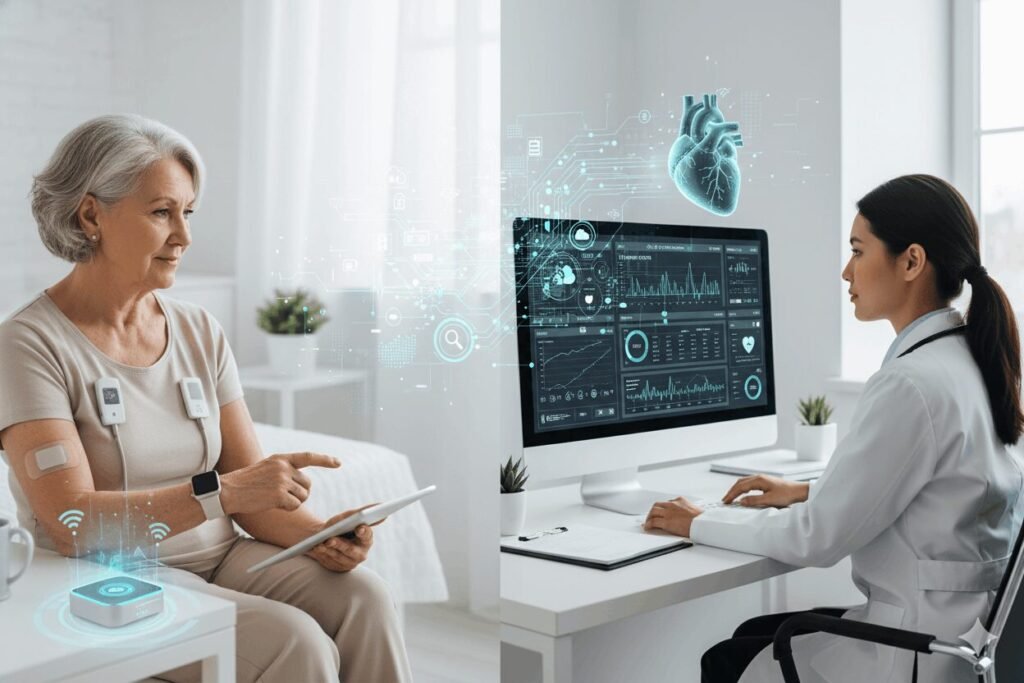
In this Q&A, Mariel Fabro, VP of Product at Vivalink, shares how remote patient monitoring platforms are being built to fit the realities of clinical care. She explores how health systems are tackling data overload, driving clinician adoption, and what scaling across service lines is revealing about patient engagement, outcomes, and operational performance.
From your perspective, what distinguishes the organizations that have successfully scaled remote patient monitoring from those that remain stuck in small deployments?
The organizations that have successfully scaled share one fundamental trait: they treat it as a care delivery transformation integrated into workflows across the care continuum. The health systems limiting their scope to a pilot effectively limit the operational perspective and may not achieve the traction within the organization. When undertaking a full implementation, these organizations tackle the fundamental aspects of integration, including change management, interoperability, logistics, and telemonitoring. In doing so, these deployments are truly a part of the hospital operations, as opposed to a research project.
Data overload is a recurring concern with connected devices. What strategies or technologies are proving most effective in helping clinicians prioritize actionable insights from the massive volume of data that RPM generates?
Giving clinicians more data without context or insights is more likely to stall adoption than it is to help. Continuous multi-modal physiological signals across ECG, blood pressure, respiratory, etc. creates a high volume of data that could obscure the critical information that should be prioritized for further assessment or intervention. We’ve implemented a tiered approach to be the most effective, built on an analytics core that processes high-volume data streams and filters noise to automate triage.
The system is dynamically processing all of the signals in near real-time based on established institutional practice and also in consideration of an individual patient’s inherent baseline. From there, nurse-led teams handle signals that cross predefined thresholds, performing assessments and protocol-based interventions. This helps respect clinician bandwidth and reduce alert fatigue, so long as insights are integrated with clinical dashboards that make it simple for clinicians to synthesize the data. The goal is less time spent to ascertain the explicit meaningful aspects of health.
What are the key design principles or product decisions that make RPM tools easier for clinicians to actually use in their day-to-day practice?
A principle we come back to constantly is familiarity, which involves replicating the workflow sequences the team is already familiar with. Change management is genuinely hard in healthcare, and clinicians are less likely to use the technology if it doesn’t easily integrate into their workflow. They’re much more likely to adopt a platform that has considered how care teams already think and work.
Adjacent to this is integration and interoperability. At Vivalink, we recognize integration as a commitment to long-standing adoption. Our approach is practical and may be step-wise depending on the extent of RPM within the organization. At the bare minimum, there is the capability for summarized health data interoperable with the EHR, simply for evidence of the encounter and supporting reimbursement.
From there, you work towards comprehensive interoperability, delivering the full workflow from enrollment, the explicit data elements (distinctly derived from high-volume continuous data) that map into the EHR, any alert-driven workflow, and reporting encounters within the care pathway through discharge. Beyond matters of workflow similarity and interoperability, RPM technologies ultimately need to be reasonably patient-centric. We often think of this as passive, unobtrusive, and accommodating the activities of daily living. This gives the most unbiased and true context in the real-world setting, which also enables adoption of the technology on the patient side. Such patient-centricity and usability will often correlate to patient adherence and engagement.
Based on your experience working with health systems, what approaches are most effective in keeping patients consistently engaged with monitoring programs over time?
Patient engagement really comes down to removing friction at every possible touchpoint. Programs that maintain consistent engagement are the ones that don’t require patients to overthink their role. Ideally, they’re wearing a device that’s already paired, transmitting, and doing the work in the background. It helps when they’re using a device they’re already familiar with. At Vivalink, we deploy equipment that’s ready to go right out of the box, which keeps things simple.
Ultimately we want to avoid asking patients to manage the bulk of the technology themselves, or feeling like the monitoring is disconnected from their actual care. Education plays a bigger role than people would expect, as patients who understand the program and feel like active participants in their care usually stay engaged longer. Additionally, the care team relationship matters just as much as the technology. Programs that struggle with engagement are usually the ones that treat onboarding as a one-time event rather than the start of an ongoing relationship.
How are changes in reimbursement shaping how health systems design and expand their RPM programs today?
Reimbursement has been the health economics limitation on remote patient monitoring for a long time. What we currently observe with CMS is a fundamental shift of the payment paradigm that recognizes the true potential of RPM. The traditional fee-for-service model was never designed to support the true value of remote monitoring, rewarding specific isolated activities instead of the kind of continuous care management that is better served by outcome-based payments.
For example, with the ACCESS Model, a 10-year voluntary CMS initiative launching in the summer, aims to push health systems to think differently about how they structure their programs and is focused on achieving measurable health outcomes. What that does in practice is create a real incentive for organizations to build RPM programs that are more proactive and longitudinal in nature. Once the incentivization establishes more reasonable health economics, the technology ecosystem closely follows with viable business models.
What practical steps can healthcare organizations take to ensure RPM programs reach underserved or digitally marginalized populations?
To truly extend high-quality care beyond the walls of a hospital, RPM needs to be fully integrated into the hospital’s care model so it can reach more patients than those who are already digitally connected and familiar with the healthcare field. The most practical starting point is device and connectivity design. Investing in devices that are intuitive and easy to use on both the facility side and the patient side helps reach patients who might be uncomfortable with technology or do not have anyone at home to help them troubleshoot. A patient should be able to use the device out of the box, not configure it and manage software updates.
Onboarding is equally critical. Every patient, regardless of geography or demographic, needs a human touchpoint, whether that’s a nurse performing a home visit or a care coordinator walking them through the setup over the phone. We’ve seen this play out directly in rural deployments, where getting the device to the patient and supporting them through the process is just as important as anything happening on the clinical platform.
As RPM programs scale, interoperability becomes increasingly important. What role do device ecosystems and platform integration play in enabling RPM to function effectively across the broader care continuum?
Interoperability is ultimately what determines whether remote patient monitoring functions as a true extension of care or falls short. Working across different health systems, we’ve learned that no single device or platform is going to cover every clinical need across every service line. For example, a cardiac patient has different monitoring requirements than a post-acute patient or someone in a virtual psychiatry program. The device ecosystem needs to be flexible enough to accommodate that without forcing the care team to work across multiple disconnected dashboards.
The platform is where that gets resolved. It should be the constant, while specific parameters and devices can remain flexible for the patient populations being served. This only works if the platform is interoperable, and in order for that to happen, data needs to be translated for the EHR. Where we see breakdowns happen most often is at transitions of care, when a patient moves from hospital to home and the monitoring data doesn’t travel with them in a way that’s visible to the next care team. Interoperability is a foundational requirement from day one.
Looking ahead, what innovations in wearable sensors, connectivity, or analytics do you believe will have the biggest impact on the next phase of remote patient monitoring?
The innovations I’m excited about are those closing the gap between hospitals and home care. On the sensor side, the trajectory is moving toward unobtrusive multi-parameter devices that capture more clinically meaningful data and are predictive in nature. As we develop more models around physiologic data, we will be able to transform the multi-parameter data into signals for understanding disease progression and ultimately propensity for disease. Today, we largely rely on medically-guided established thresholds and alerting clinicians, so the next phase is AI-driven predictive intelligence that can identify patterns in a patient’s trajectory, their risk stratification, and to ultimately prevent higher-severity events. When you combine that with an interoperable platform and patient-centered device design, RPM stops being a monitoring tool and starts functioning as proactive care management.