


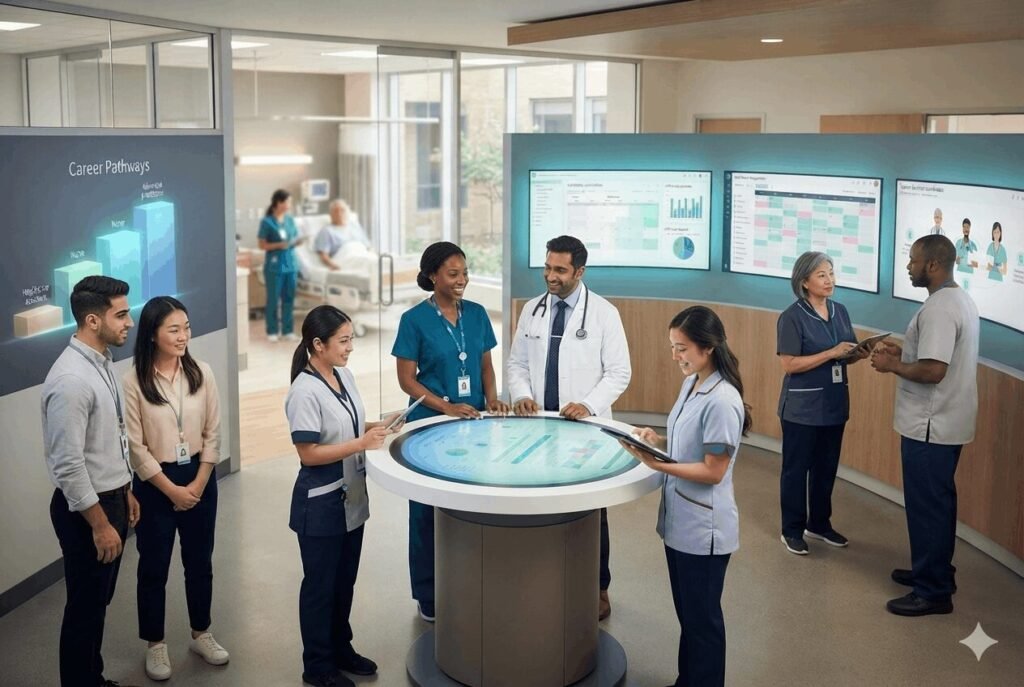
Workforce analyst Nehal Nangia shows how a redesign of work, scheduling, and career pathways is needed to tackle the growing worker crisis
Healthcare systems face a growing global shortage of licensed workers, with the WHO warning that it will be 11 million short by 2030. Meanwhile, the U.S. specifically is facing a shortfall of up to 86,000 physicians by 2036, alongside similar gaps for nurses and mental health professionals.
When compounded with unoptimized processes and job design, it’s a worrying combination for healthcare. One prominent American healthcare network, Providence Health & Services, found that its clinicians were spending over 40% of their time on nonclinical tasks rather than on top-of-license activities. In response, their leaders deconstructed every role and operational process to its most granular level, redirected scheduling and administrative tasks to AI-enabled systems, and partnered with Amazon to retrain warehouse workers as medical assistants—ultimately freeing clinicians to focus more fully on patient care, with great success.
Traditional hiring approaches cannot solve the problem
This need to reimagine large parts of the healthcare day-to-day emerged from new Josh Bersin Company research on how organizations approach talent and technology strategies for frontline workers, with an emphasis on healthcare.
It explores how traditional hiring approaches cannot solve the problem because the pipeline takes too long to build. The real competitive advantage for healthcare organizations in solving the existing & impending workforce gap lies in redesigning work, offering flexible and predictable scheduling, and building structured career pathways – rather than waiting for vacancies and competing in a shallow external labor market.
For example, take the Ascend program by nationally recognized nonprofit health care system UCHealth. It offers fully funded tuition for a wide range of clinical and nonclinical programs, creating defined educational pathways from entry-level and nonclinical roles into in-demand clinical positions, including respiratory therapists, medical assistants, pharmacy technicians, and radiography technologists.
Program participants show three times higher retention rates, and underrepresented groups enroll in nursing programs at rates far exceeding their current representation in the workforce. This kind of long-horizon, pathway-based strategy improves retention and diversifies the pipeline into specialized and leadership roles, and is exactly the imaginative response needed.
Segmentation is key
Our research also identified the need for better segmentation of ‘frontline’ healthcare workers. For too long have many organizations taken a blanket approach to management strategies for all ‘frontline workers,’ whereas in reality healthcare frontline work spans every type of job from entry-level operational staff to technical/licensed specialist workers through to highly credentialed physicians and surgeons.
Without a proper understanding of the complexity of different workers’ specific needs, there is a real risk of creating staffing models that fail to match skills to tasks in the most efficient manner, misallocating training investments, failing to save people from the risk of burnout, and, as in the Providence example, leaving expensively-credentialed clinical staff spending time on non-clinical tasks.
So, dedicate time to understanding the specific issues each level of frontline worker faces. Start with meaningful segmentation based on shared skilling needs, talent risks, retention drivers and technology enablers. The Josh Bersin Company has developed a clear and practical segmentation model that applies across all healthcare worker populations:
Customer-facing associates, such as receptionists, patient coordinators, call center staff, etc., who are always the first point of patient interaction, suffer with high turnover and inconsistent styles that directly degrade patient experience. Meanwhile, back office associates—all the cleaners, laundry staff, food service, and logistics workers who are essential to both hygiene and operations- have both very physical jobs but are also often unrecognized, and need more recognition and investment.
Technicians, supervisors, and mid-level operational leaders, who are critical to overall system efficiency, don’t see any career path for them to reach real leadership level, resulting in high churn, while licensed nurses, therapists, and specialized clinical practitioners can’t take much more of the on-the-job fatigue, lack of scheduling flexibility, and so on.
A new horizon for healthcare workforce management
As a priority, healthcare leaders must focus on:
- Ensuring staffing models more closely align with the realities of each function in 2026.
- Reducing the administrative burden placed on clinicians wherever possible.
- Designing scheduling systems that accommodate employees’ professional responsibilities alongside their personal lives and career aspirations.
- Developing targeted retention strategies for critical workforce segments.
- Continuously improving patient outcomes through greater workforce stability.
While technologies such as AI will undoubtedly play a significant role in this transformation, their successful adoption will also depend on organizational redesign. A number of guiding principles prove especially important:
- Frontline roles should no longer be treated as a single, homogeneous workforce; effective segmentation should form the foundation of healthcare workforce redesign.
- Specialist time should be rigorously protected to ensure professionals are able to operate consistently at the top of their license.
- Long-term workforce pipeline planning should be prioritized, recognizing that many licensed roles require planning horizons of three to ten years.
- Scheduling should be viewed as a patient safety mechanism rather than simply an operational process; greater predictability should be provided through working arrangements that support both employees and the patients they serve.
- Administrative responsibilities should be reallocated wherever possible, with automation and support functions absorbing as many non-clinical paperwork tasks as practicable.
The data we have shows what happens when a highly complex workforce is managed as a single category: burnout, inefficiency, and structural shortage. Now, it’s time for healthcare workforce strategy to move on and evolve.
Nehal Nangia is Senior Research Director at The Josh Bersin Company, where she leads empirical research around all talent management topics with a deep focus on frontline workforce strategies