


Inequality is a primary challenge for the United Kingdom’s public healthcare system. The National Health Service (NHS) is grappling with the complex needs of an ageing population, rising demand, workforce shortages, and inadequate funding. People from poorer sections of society, ethnic minority groups, and deprived areas have significantly lower access to healthcare. Consequently, those living in most deprived regions experience emergency hospitalisation rates for infectious disease nearly double that of people in the least deprived areas. Further, people from the North of England, coastal towns, and parts of the Midlands, have an eighteen year lower healthy life expectancy than the residents of affluent regions.
There is an urgent need to improve access to local healthcare and preventative services. Technology can directly contribute to this by enabling a digital-first community care model that brings healthcare closer to people and helps providers deliver tailored interventions.
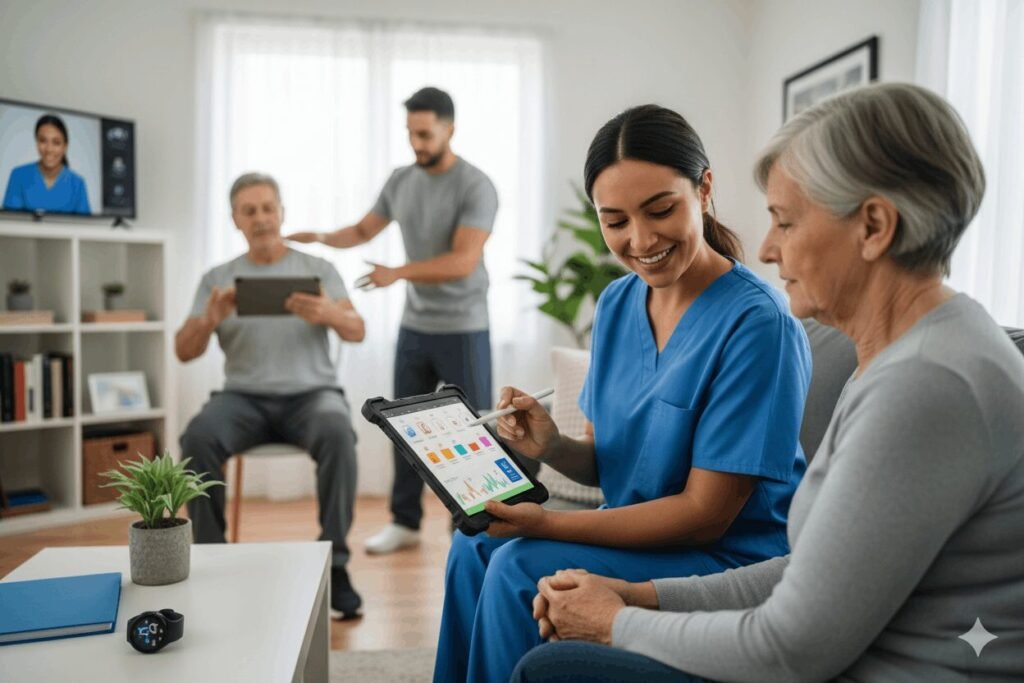
Digital-first community care models improve health equity by making treatment more accessible and efficient for underserved populations. Designed to serve community health workers (CHWs) and local needs, the models integrate digital solutions such as telemedicine, remote monitoring, and data analytics to support both providers and recipients of healthcare services. Key use-cases include:
Remote patient monitoring (RPM)
Wearables and sensors on medical devices continuously monitor patients’ health parameters, such as blood pressure or glucose levels remotely. This enables early detection of health issues, facilitating timely intervention and efficient management of chronic conditions. The NHS has already implemented virtual wards to support patients recovering from conditions like heart failure or COPD at home. By shifting care to the patients’ location, RPM improves healthcare coverage in underserved communities; and can address linguistic or cultural barriers with adaptive interfaces and simplified medical insights.
Telehealth and remote consultation
Virtual platforms connect patients in rural or remote areas with specialists in urban centres, saving them the time and expense of travel. Telemedicine proved invaluable during the pandemic, sustaining care delivery despite lockdowns. For example, the Queen’s Nursing Institute leveraged videoconferencing to provide clinical support for a variety of ailments, from cardiac diseases to dental problems, finding particular success in triaging nail surgery through video consultation.
Personalised healthcare guidance
Using AI and machine learning to analyse data, including medical history, genetic information, and lifestyle choices, U.K.’s healthcare providers can create individualised treatment plans and even predict the next best action to create proactive, personalised, and effective interventions. Mobile health apps empower patients with self-monitoring tools and healthcare education. AI tools can also lighten the burden on U.K.’s overstressed healthcare system by optimising operations like streamlining appointment scheduling and resource utilisation, helping providers cope better with rising demand.
Data and analytics
Digital systems integrate health information from various sources, including medical history, wearable devices, and the patients themselves, into a single platform. Analytics solutions process this data to improve providers’ understanding of patients, including social determinants of health (SDOH) – earnings, job status, housing, and other social factors shaping living conditions that also influence health and health inequalities.
Digital-enabled community health
Community health, delivered by community health workers (CHW) and pharmacies, acts as a critical bridge between the formal healthcare system and local communities. Digital technologies can streamline manual tasks and organize workflows for CHWs, improving their reach and effectiveness.
Electronic health records (EHRs) and mobile data collection apps offer real-time insights into disease outbreaks and health trends, while e-learning tools provide on-demand training enabling CHWs comply with follow-up care protocols. AI can also analyse vast datasets to forecast patient needs, enabling local pharmacies – often the first point of contact for patients seeking treatment – to maintain adequate stocks of medicine.
While digital technologies can undoubtedly transform U.K.’s community healthcare, challenges remain. These include fragmented digitalisation, inadequate options, and insufficient accessibility features. Current efforts have also not involved end-users in the service development process, leading to unfulfilled expectations and disappointment. A significant issue is that segments with poor healthcare access are often also digitally excluded.
For a digital-first community care model to succeed, it must incorporate the opinion of patients and local communities from the start. Technology is necessary for building digital health services, but community engagement is vital for creating inclusion, trust and equitable access needed for a healthier future.
By Venky Ananth, EVP and Global Head of Healthcare, Infosys