



Remote monitoring is usually described as technology: a cuff, a sensor, a dashboard. The description leaves out the people. Every device sends readings that someone must look at, and every patient sent home with a kit is one phone call away from giving up on it.
That work has a name in few business cases. It is the support layer, and in 2027 a growing part of it is being supplied through digital health outsourcing to the Philippines for remote monitoring and patient onboarding: nurses and technicians who onboard patients, screen alerts and keep the devices talking. For NHS and healthtech leaders the questions are what this layer does, how large it needs to be, and which parts can safely sit 6,700 miles from the patient.
Why Does Remote Monitoring Need a Human Support Layer in 2027?
Because most alerts do not need a clinician, yet someone has to check every one. In a 2026 study of 407 heart failure patients monitored at home, devices generated 19,788 alerts over 18 months and only 7.5 per cent required medical intervention. A technician screened the alerts before a cardiologist saw them.
The study, from a single centre in Warsaw and published in August 2026, counted 2.8 alerts per patient each month, of which about one in thirteen was clinically significant. Its authors concluded that the small actionable share created substantial workload and recommended structured triage. Implanted cardiac devices are not the same as a virtual ward kit, but the shape of the problem carries over.

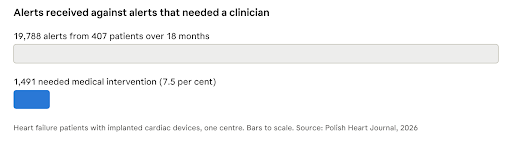
Figure 1. Remote monitoring alerts received and alerts needing medical intervention. The value is in the small bar. The cost is in checking the large one.
England’s virtual wards show the pressure. NHS England publishes monthly capacity and occupancy data, and an analysis of the January 2026 figures reported a record 11,474 patients, 90 per cent occupancy of 12,725 beds, and capacity up by only 98 beds in a year. Demand is rising faster than the teams behind it.
What Does the Support Layer Do, and Which Parts Can Sit in the Philippines?
Four jobs: onboarding patients and setting up devices, screening alerts against written thresholds, chasing missing readings, and technical help. All four can be done by Philippine nurses and technicians. Deciding what an alert means for a patient, and acting on it, stays with the UK-registered clinicians who run the virtual ward.

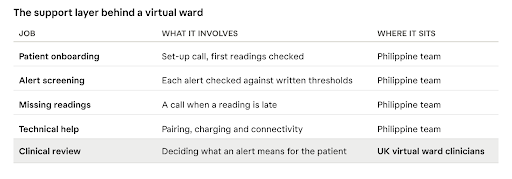
Table 1. Support jobs behind remote monitoring and where each can sit. Four supporting jobs and one clinical one. The boundary is the decision about the patient.
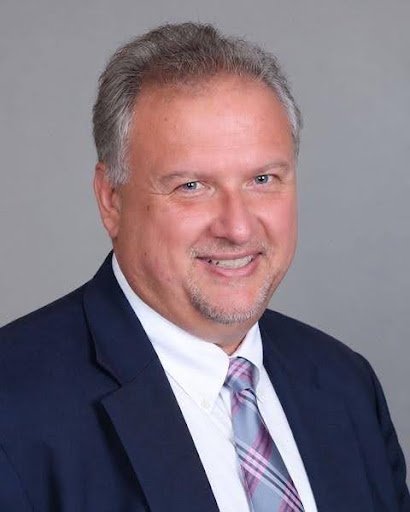 CEO, PITON-Global |
“A virtual ward is a contact centre with clinical consequences,” says John Maczynski, CEO of PITON-Global and previously an EVP with the world’s largest contact centre outsourcing group, whose advisory work covers remote monitoring and digital health support teams in the Philippines. “Most of what arrives is routine. The skill is in building a first line that handles the routine reliably and passes the rest upward quickly.” |

Maczynski, whose earlier medical technology clients included Philips Healthcare, argues that the Philippines suits the work for a specific reason: its outsourcing sector is staffed with nurses. A screener who understands why a falling oxygen saturation matters more in one patient than another will escalate better than one following a colour code.
How Much Human Support Does a Virtual Ward Need?
On planning assumptions, a 100-patient virtual ward generates about 18.7 hours of support work a day. Covering it with two trained people for 12 hours a day, seven days a week, takes 8,736 hours a year. From the Philippines, at £11.40 an hour, that costs about £99,590, or £2.73 per patient per day.

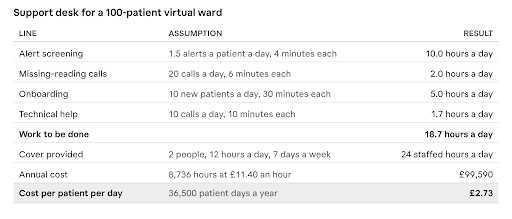
Table 2. Planning model for a 100-patient virtual ward support desk. Assumptions for illustration. A service should replace each with its own activity data.
The rate is $15 an hour for clinically trained staff, converted at £0.76 to the dollar, and covers salary, supervision, equipment and leave cover. The 12-hour, seven-day pattern is deliberate. NHS England’s winter planning letter for 2026/27 asks systems to make senior clinical decision-making available through a single point of access at least 12 hours a day, 7 days a week, alongside virtual wards and Hospital at Home. A support desk that keeps different hours from the clinicians it feeds is of limited use.
Two people give 24 staffed hours against 18.7 hours of work, a utilisation of 78 per cent. One person would give 12 staffed hours against the same 18.7, so more than a third of each day’s work would go undone. The slack matters. “Commissioners ask what a virtual bed costs,” notes Ralf Ellspermann, who is PITON-Global’s strategy chief. “I would ask what it costs when an alert sits unread for three hours because the one person on shift was on a set-up call.”
The model scales in steps. A 30-patient ward still needs someone on shift for all 84 hours of the week: one person, 4,368 hours, £49,795 a year, or £4.55 per patient per day. Small services pay most per patient, which is the practical case for a desk shared across several wards, whether an NHS collaborative or an outsourced provider runs it.
What About Patients Who Struggle With the Technology?
They are the reason the layer has to be human. Some 2.2 million UK adults are offline and 8 million lack basic digital skills, according to Good Things Foundation. Among people given hands-on support, 74 per cent say online tools help them manage their health. A phone call can do what an app prompt cannot.
The charity’s Digital Nation 2026 analysis found that only one adult in three is comfortably online, while 34 million are online with barriers such as low skills or data poverty.
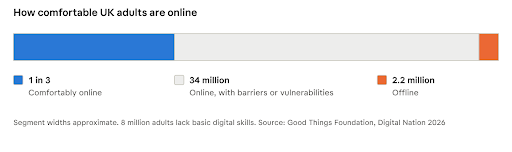
Figure 2. UK adults by digital confidence, 2026. Remote monitoring is designed for the left-hand segment. Most patients are in the middle one.
Virtual ward patients are older and sicker than the average adult, so the middle and right-hand segments will be over-represented among them. “The patients who gain most from being monitored at home are often the least comfortable with the kit,” Maczynski observes. “In my experience of device support, a ten-minute set-up call does more for adherence than any feature in the app.”
None of this argues against automation. AI can already draft the reminder, read the trend and sort the queue, and Health Tech World has reported on healthcare outsourcing to the Philippines paired with agentic AI in NHS care pathways. The patient who cannot pair a device still needs a person on the line.
What Should NHS and Healthtech Leaders Put in Place for 2027?
Written alert thresholds owned by the clinical lead, an escalation time measured in minutes, patient data kept on UK systems and viewed remotely, a data protection impact assessment and transfer agreement, and a monthly audit of the alerts the support team screened out. The support layer should be commissioned with the service.
Five controls follow from the evidence above:
- Thresholds and scripts signed off by the virtual ward’s clinical lead, with version control.
- A maximum time from alert to clinician for anything outside threshold, reported weekly.
- A sample of screened-out alerts reviewed by a clinician each month, so that misses are found.
- Set-up calls offered to every patient, with a record of who declined.
- Access through the provider’s own UK-hosted platform, with no data stored offshore.
Where these services disappoint, Maczynski finds, the support layer was usually an afterthought: someone bought the platform, assumed the ward nurses would absorb the alerts, and found six months later that they could not.
Healthcare Newsdesk has traced the broader shift in its overview of how UK providers are using healthcare outsourcing to the Philippines in an AI-driven market. PITON-Global provides its healthcare advisory and supplier-sourcing service at no cost to NHS organisations and healthtech companies, and without any commitment on their part.
Frequently Asked Questions
What is digital health outsourcing to the Philippines?
It refers to Philippine-based nurses and technicians doing the human work that digital health services depend on: onboarding patients to devices and apps, screening remote monitoring alerts, following up missing readings and providing technical help. Clinical decisions remain with the registered clinicians running the service.
Can an overseas team monitor NHS virtual ward patients?
It can support the monitoring. Screening alerts against thresholds set by the clinical team, and passing on anything outside them, is a support task. Assessing the patient and deciding what to do is a clinical one and stays in the UK. The NHS organisation remains the data controller throughout.
Does remote monitoring reduce the need for staff?
It changes where staff are needed. Fewer people are at the bedside, and more are needed to watch the data and support patients at home. In one 2026 study only 7.5 per cent of alerts needed medical intervention, but all of them needed checking.
How much does virtual ward support from the Philippines cost?
On the planning model in this article, a two-person desk covering 12 hours a day, seven days a week costs about £99,590 a year, or £2.73 per patient per day for a 100-patient ward. A 30-patient ward staffed by one person works out at £4.55, which is why smaller services gain most from sharing a desk.