


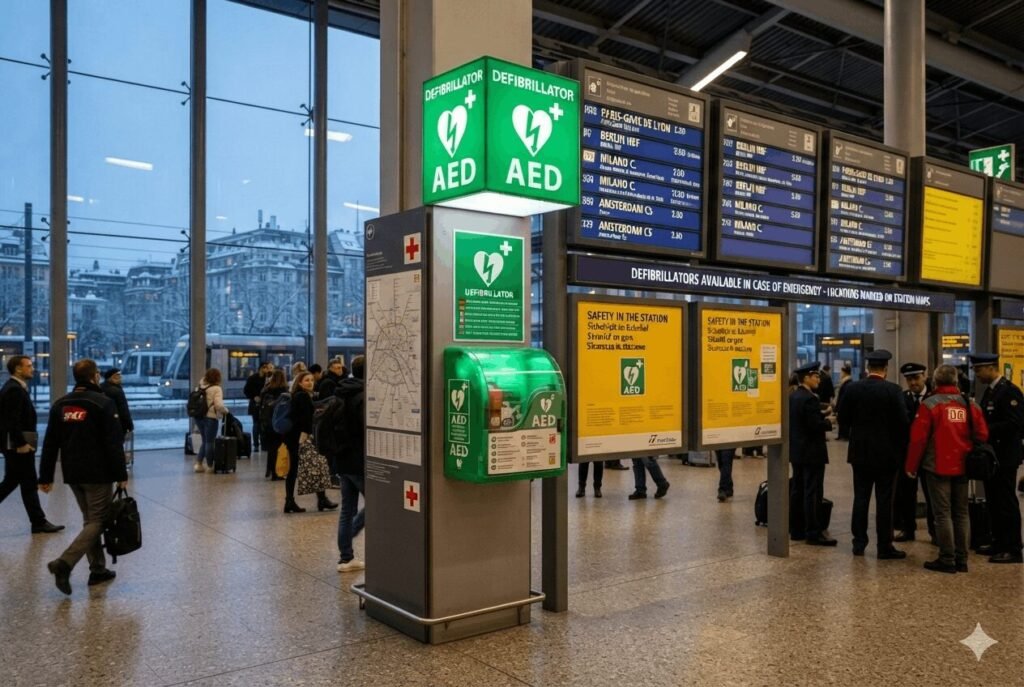
Rail stations across the Netherlands have been fitted with modern defibrillators, creating a time-critical lifeline for passengers who suffer sudden cardiac arrests, and for surrounding communities.
Across the Netherlands, an enhanced emergency response system is taking shape. It is one that most people pass every day without noticing, yet one that can make the difference between life and death.
From railway stations, to airport spaces, supermarkets, and city streets, automated external defibrillators (AEDs) are becoming part of the country’s public safety infrastructure, extending emergency care far beyond hospital walls.
Where the city’s heart beats
The country’s railway network, managed by ProRail and NS, is one of the busiest in Europe serving both domestic and international travellers. Stations sit at the centre of this flow, connecting places, and millions of people. With nearly 90% of sudden cardiac arrests occurring outside hospitals [1], this also makes them critical points of vulnerability.
A sudden cardiac arrest can happen without warning, in the middle of a commute or on a crowded platform. Every second counts in such scenarios, where survival can depend on immediate response and the efficiency and readiness of the entire emergency response system.
A national first-aid system along the railway
The Netherlands is widely regarded as one of Europe’s leading[2] countries in public-access defibrillation, with among the highest AED density, bystander response rates, and survival outcomes.
To address the challenge on the country’s railway service, ProRail and NS have systematically integrated AEDs from international health tech company Mindray into the railway network, ensuring that every station is equipped as part of a nationwide initiative. Since 2021, deployment has expanded from 50 stations to its current level of 100% AED coverage across all train stations.
Each AED typically covers approximately 500 metres, meaning that accessibility of lifesaving devices is also improved for urban areas.
Sander de Hek, asset manager, for ProRail, says: “A lot of stations are also located in the centre of cities. So, by contributing to a network of further increasing public AEDs, it increases the chance of survival for people who are having a cardiac arrest who are close to a station.”
Technology empowering every rescuer
Aligned with the vision of ProRail and NS, Mindray has supported an enhanced emergency response system that meets advanced international standards, addressing real-world challenges across diverse patient groups and scenarios.
Bert Glismeijer, a safety advisor for NS Station, said: “It’s vital that AEDs are always ready for use. Maintaining these high standards in an efficient way is one of our key priorities.”
During rescues, a compliant AED is not only technically qualified but also easy to use – including for lay people.
AED solutions that have deployed are designed with this in mind. Qshock delivers shocks rapidly to minimise interruptions during resuscitation, while supporting 360 joules to adapt to different patient conditions. For example, patients with complex disease histories, ages, or body shapes.
ResQNavi has also been deployed from Mindray, providing users with clear, step-by-step instructions, automatically offering more detailed prompts when hesitation is detected, to finish the rescue.
Extending connected healthcare into everyday life
Beyond the railway network, the reach of this safety system is extending much further. Across the Netherlands, AEDs are now widely available in high-traffic public spaces, including Schiphol Airport and 90% of Dutch supermarkets, where more than 1,500 units have been installed.
Together, these deployments form a strong public-access defibrillation programme, deeply embedded into daily life.
However, accessibility of devices is only part of the solution. Building an effective response system depends on more than just devices. Public awareness and CPR training are essential to leverage people’s willingness and readiness to rescue, with more programmes now being launched to wider regions and countries.
Ricky Xu, General Manager of Mindray North West Europe, said: “AED should be accessible and usable for everyone. This is a long-term commitment to safeguarding journeys, public spaces, and lives across the Netherlands. We are committed to helping to redefine public safety and enhancing the resilience of every community we serve.”
References
[1] https://www.erc.edu/for-everyone/what-is-cardiac-arrest/did-you-know-facts-figures/
[2] https://link.springer.com/article/10.1007/s12471-020-01504-z